
How to reduce electricity bills in your company?
Rising energy costs are keeping business owners up at night. In the face of increasing electricity prices and growing pressure to improve energy efficiency, facility modernization is becoming a key element of operational cost management strategies. One of the most affordable solutions is upgrading lighting systems - an investment that delivers quick savings and can boost employee productivity by up to 3%.
How to save on electricity?
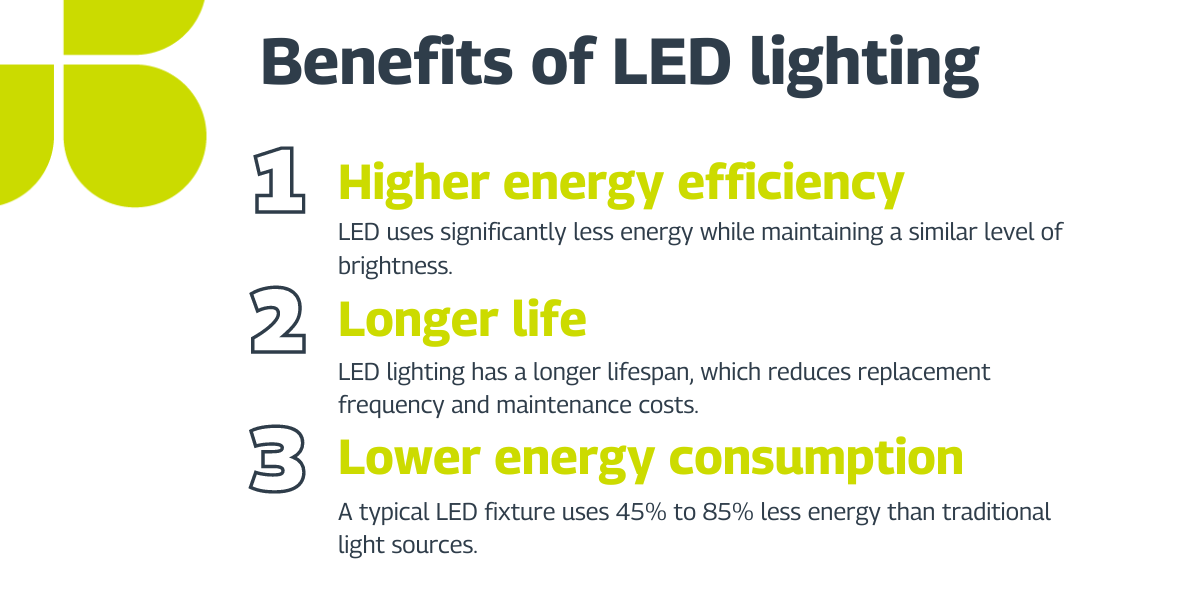
One of the most effective modernization solutions is switching to LED lighting. LED light sources offer significantly higher energy efficiency and longer lifespan compared to traditional sources, leading to substantial electricity savings and reduced maintenance and replacement costs for bulbs, fluorescent lamps, or halogens. Potential savings range from 45% to even 85%.
In general, LED lighting consumes much less energy than traditional incandescent bulbs or compact fluorescent lamps, while maintaining a similar level of brightness. For example, a linear fixture with a power of 2x56 W can be replaced with a 42 W LED fixture, resulting in energy savings of 70 W.
Let’s consider a specific case of replacing the main lighting of a production hall, where 95 fixtures with a power of 400 W each (drawing 440 W) and 27 fluorescent fixtures 2x36 W (drawing 80 W each) are used, operating on average 8,760 hours per year. It is worth noting that this hall is one of eleven areas of the entire industrial complex, which also includes several technical and administrative buildings.
Energy consumption before switching to LED:
- Energy consumption per fixture: 440 W
- Energy consumption per fluorescent fixture: 80 W
- Total energy consumption: 440 W x 95 + 80 W x 27 = 41,800 W + 2,160 W = 43,960 W = 43.96 kW
- Annual energy consumption: 43.96 kW x 8,760 hours = 385,089.6 kWh
Energy consumption after switching to LED:
- ULT3-IV-NW-DGT-90°-HPT-DALI fixtures with 145 W power used in quantity of 65
- Total energy consumption: 145 W x 65 = 9,425 W = 9.425 kW
- Annual energy consumption: 9.425 kW x 8,760 hours = 82,563 kWh
Energy savings after switching to LED:
- Annual energy savings: 385,089.6 kWh - 82,563 kWh = 302,526.6 kWh
- Assuming an energy cost of 1.15 PLN per kWh, annual savings amount to: 302,526.6 kWh x 1.15 PLN/kWh = 347,905.59 PLN
It is also worth noting that these savings will increase as LED technology advances and more sophisticated control systems are applied, further reducing energy consumption. In the case of larger industrial facilities, the potential savings are even more significant.
How to save on lighting?
In addition to switching to LED technology, there are several other ways to save energy directly related to lighting in industrial facilities:
Use of daylight regulation systems
Daylight regulation systems allow for maximum use of available natural light, further reducing energy consumption. Daylight sensors automatically adjust artificial lighting intensity depending on lighting conditions, contributing to energy savings.
Installation of high-efficiency lighting fixtures
Lighting fixtures with high luminous efficacy allow achieving the required brightness at lower energy consumption.
Regular maintenance and servicing
Cleaning and maintaining lighting fixtures, replacing damaged or worn components, and checking the proper functioning of control systems help ensure optimal lighting performance with minimal energy use. This not only ensures longer equipment lifespan but also reduces electricity consumption.
Use of reflectors and directional lighting
Using reflectors and directional lighting allows focusing light on specific work areas, reducing energy consumption by eliminating unnecessary lighting.
Smart lighting control systems
These systems, based on advanced sensor and automation technologies, allow dynamic adjustment of lighting intensity to actual needs, depending on the presence of people, natural light levels, or time of day:
Take a step towards cost-effective decarbonization of your business
Contact usSummary
The use of advanced lighting technologies such as LED and smart control systems allows for significant energy cost reductions, increased operational efficiency, and improved working conditions. These actions result not only in cost savings but also in reduced environmental impact, which is crucial in today’s sustainable business landscape.
In addition to direct financial savings, lighting system modernization contributes to improved employee productivity, which in the long term brings even greater benefits to businesses. According to research, good light quality and optimal intensity can increase employee productivity by 1–3%. The implementation of modern lighting solutions is therefore an investment that pays off quickly and delivers long-lasting benefits.
