
Efficiency of compressed air systems
Compressed air systems are among the most energy-intensive auxiliary systems in industrial facilities. In many enterprises, they account for a dozen or even several dozen percent of total electricity consumption. Despite this, for years they have been treated as background infrastructure supporting production processes, without regular efficiency analysis. Meanwhile, improving the efficiency of compressed air systems is one of the fastest and most predictable ways to reduce energy consumption and operating costs.
What does an efficient compressed air system mean?
An efficient compressed air system is one that delivers the required volume of air at the appropriate quality and pressure parameters, while consuming as little energy as possible and minimizing losses throughout the entire system – from the compressor to the end-use points.
Efficiency covers the entire setup: generation sources, air treatment systems, storage, distribution network, and the way compressed air is used in technological processes. A system may be technically operational yet still highly energy-inefficient if it runs at excessive pressure, has numerous leaks, or is poorly matched to the facility’s actual demand.
In practice, a well-optimized compressed air system is one in which:
- compressed air losses are minimized,
- operating parameters reflect real process requirements,
- air production is flexibly adjusted to variable load conditions,
- the energy contained in waste heat (e.g., from compressors) is rationally utilized.
Main sources of losses in compressed air systems
Energy losses in compressed air systems occur at many levels and often accumulate over time. They are typically dispersed, which makes them difficult to detect without proper measurements and an audit. The most significant issue is leakage. In older systems, losses due to leaks often reach 20–30% of total compressed air production, and in extreme cases can exceed 50% in very extensive networks. Leaking connections, quick couplings, valves, or flexible hoses result in continuous air discharge, often even during production downtime.
Another major source of losses is excessively high operating pressure. In many facilities, pressure is increased as a precaution to compensate for system pressure drops or local equipment issues. However, each additional bar results in a noticeable increase (approximately 8%) in compressor energy consumption.
Contaminated filters, improperly selected dryers, or unnecessarily high air purity classes cause additional pressure drops that must be compensated by increased compressor workload. The distribution network itself can also be inefficient – undersized piping diameters, long transmission routes, and numerous bends and branches increase flow resistance and reduce parameter stability.
Why is compressed air one of the most expensive utilities in industry?
Compressed air is one of the most expensive energy carriers in industrial facilities, even though the air itself is freely available. This results from the low efficiency of the entire energy conversion chain. Of the total electrical energy consumed by compressors, only a few percent is effectively utilized as useful energy in compressed air at the point of use. The vast majority of energy is converted into waste heat or lost due to pressure drops, leaks, unloaded operation, or inefficient control.
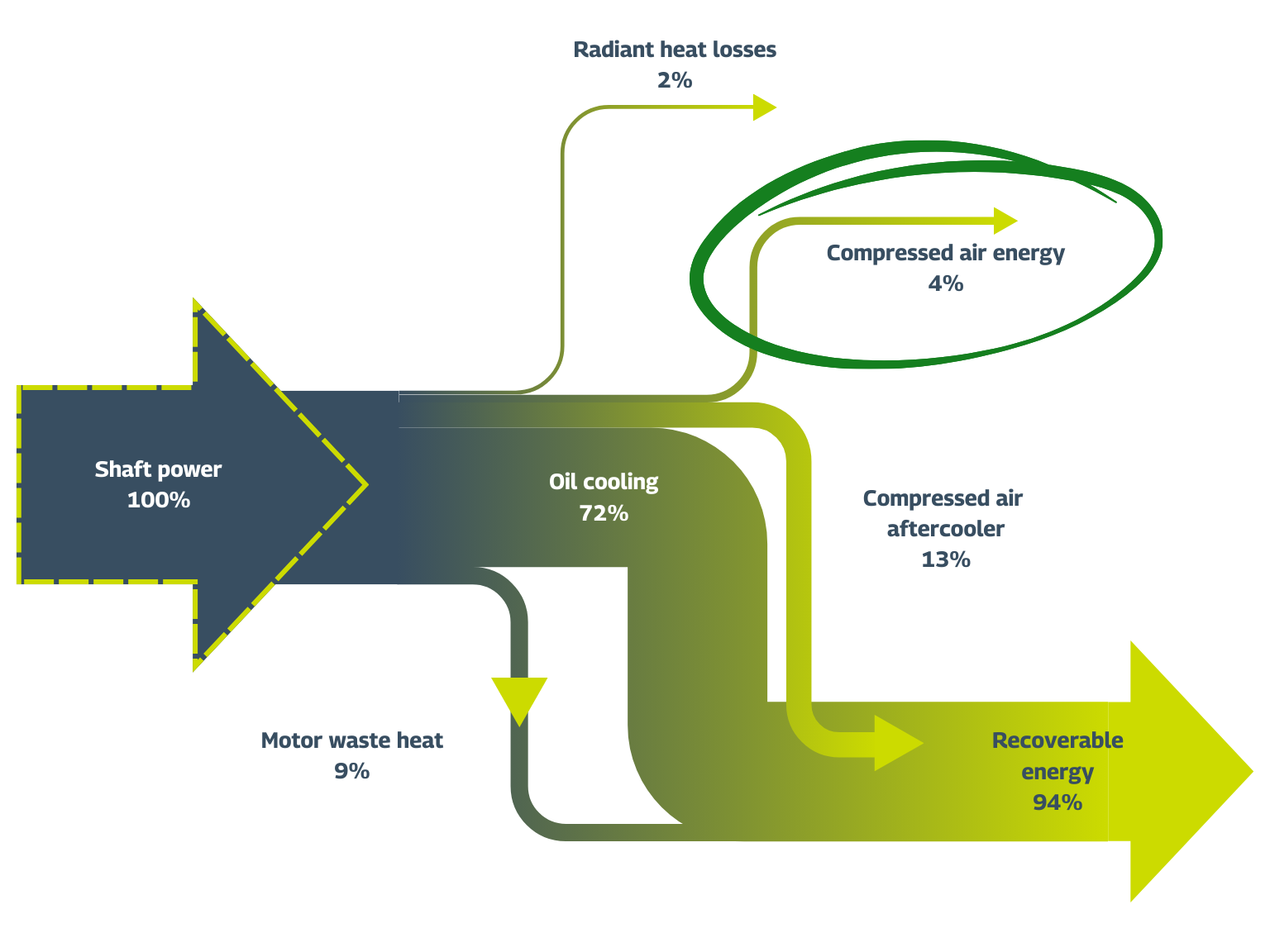
This means that each unit of compressed air carries a high energy cost. Additionally, this medium is often used inefficiently – for cooling, blow-off operations, or applications that could be handled by less energy-intensive methods. In practice, lack of control over a compressed air system leads to a situation where a facility incurs consistently high energy costs without full awareness of their actual structure.
How to reduce compressed air losses?
Improving the efficiency of a compressed air system rarely relies on a single measure. The best results come from a systemic approach that includes both technical and organizational actions.
The foundation is regular leak detection and sealing. Audits using ultrasonic detectors allow rapid identification of loss points, even in hard-to-reach areas of the system. Implementing a cyclical inspection and repair program alone often delivers measurable energy savings.
At the same time, it is worth analyzing actual pressure demand. Reducing pressure across the entire system or separating zones with different requirements can significantly decrease energy consumption without affecting production processes. In many cases, only individual receivers require higher pressure, yet the entire system has been configured around them.
In systems with multiple units, lack of coordination leads to frequent starts, unloaded operation, and unstable parameters. The implementation of central control systems and variable-speed compressors enables better matching of compressed air production to current demand.
Modernizing key sections of the distribution network, increasing pipe diameters, or redesigning the system layout often reduces pressure drops without interfering with the generation source.
Heat recovery from compressors is also increasingly implemented. A significant portion of the electrical energy consumed by compressors is converted into heat, which can be used for space heating, domestic hot water preparation, or to support technological processes.
How does the modernization of a compressed air system proceed?
The complexity of compressed air system modernization varies significantly depending on the scope of planned measures. Some improvements can be implemented without production downtime and with limited investment, while others require deeper intervention in the facility’s infrastructure.

The simplest actions, such as sealing leaks, adjusting pressure, or optimizing compressor operating schedules, involve low complexity and a short payback period. They typically do not require detailed design work or extended shutdowns. More advanced modernization projects – including compressor replacement, distribution network reconstruction, or implementation of heat recovery systems – require thorough technical analysis, measurements, and coordination with maintenance and production departments. In such cases, phased planning is essential to minimize the impact on process continuity.
What are the benefits of improving compressed air system efficiency?
The main advantage of compressed air efficiency improvement projects is the rapid and straightforward reduction of operating costs. Energy consumption in these systems is measurable, and the effects of implemented measures are relatively easy to verify. In many cases, noticeable savings can be achieved without radicaltechnological changes.
An additional benefit is improved system reliability. Reduced leakage, more stable pressure, and better air quality translate into fewer equipment failures and longer service life of end-use devices.
One drawback of such projects is their relative “invisibility.” The results are not always spectacular from a production perspective, which may make it difficult to justify investment without solid measurement data. Another challenge is the need to involve multiple departments and maintain long-term operational discipline (e.g., regular inspections and predictive maintenance).
Summary
Improving the efficiency of compressed air systems is not a one-off project, but an ongoing process requiring regular monitoring, measurement, and adjustment. Production conditions change over time, as does compressed air demand. Only a systemic approach allows achieved results to be maintained and energy costs to be effectively reduced in the long term. A properly designed and managed compressed air system becomes not only less energy-intensive but also more reliable and better aligned with the needs of modern industry.
It is worth emphasizing that compressed air systems are well suited to phased optimization – without the need to implement one large investment project. Starting with measurements, loss identification, and low-complexity actions allows organizations to build a solid data foundation and energy awareness. Only on this basis should decisions about more advanced modernization be made, grounded in the actual consumption profile and operational needs of the facility rather than in design assumptions made many years ago. This approach significantly reduces investment risk and increases the durability of achieved results.
